The Flagpole Test: Choosing a Carnival Meeting Point That Actually Works
Every carnival has that one landmark everyone points at. Sometimes it is the church clock, sometimes a war memorial, sometimes a flagpole that has stood on the village green since before anyone can remember. It is tempting to say 'meet by the big thing' and move on. But a good meeting point is not just visible. It is fixed, staffed nearby and simple enough for a seven-year-old to repeat back to you in a noisy field.
Here is a practical family plan for 2026 that does not rely on perfect mobile signal, a fully charged phone or everyone remembering the same instructions at the same time.
The flagpole test
Before you settle on a rendezvous point, run it through a quick test. Can you see it from more than one side of the carnival? Can you describe it in six words or fewer? Does it stay in the same place all day?
A flagpole, a clock tower, a bandstand or a solid stone memorial usually pass. A bouncy castle, a balloon arch, a burger van or the main stage are trickier. Vans move, queues shift and stages become magnets for crowds. Toilets are another common choice that sounds sensible and quickly becomes a sea of identical doors and pushchairs.
Ask yourself: if I were on the other side of the field and my phone died, could I find this spot? If the answer is maybe, choose somewhere else.
Pick two points, not one
One meeting point is good. Two is better. Choose a primary spot near the middle of the action but away from loudspeakers, and a backup near somewhere staffed, such as the first aid tent, the welfare tent or the stewards' base.
Then explain the route out loud. Something like: 'If you get to the flagpole and no one is there, wait five minutes. Then walk to the blue first aid tent and tell a steward.'
The five-minute rule matters. It stops children from wandering in circles and stops adults from sprinting off in six directions at once. On arrival, walk the route together once. It takes two minutes and makes the plan feel real rather than theoretical.
The wristband that does actual work
For younger children, a simple wristband with a parent or guardian's mobile number is worth its weight in gold. Write the number clearly with a waterproof marker, or ask a steward whether the carnival has ready-made family wristbands.
Keep it simple. A first name or initials plus a contact number is usually enough. If a child has additional needs or may not be able to explain what has happened, add a short note such as 'may not speak when anxious' and a second contact number.
Do not rely on a child carrying a phone. Phones get dropped, batteries go flat and pockets are not always reliable. A wristband is boring, cheap and extremely effective.
The if-we-get-separated script
Agree a short script before you leave the house. Keep it calm and repeatable. For a younger child, it might be: 'Stop. Look for the flagpole. If you cannot see it, stay where you are for two minutes. Then find a steward in a high-vis jacket and say: I am lost, my grown-up is at the flagpole.'
For older children, add the backup point: 'Go to the flagpole, wait five minutes, then go to the first aid tent and speak to a steward.'
Parents need a script too. One adult stays at the meeting point. The other alerts a steward with a description, last seen location and what the child is wearing. Do not both leave the meeting point to search. That is how a five-minute regroup turns into a twenty-minute one.
Talk to the people in high-vis
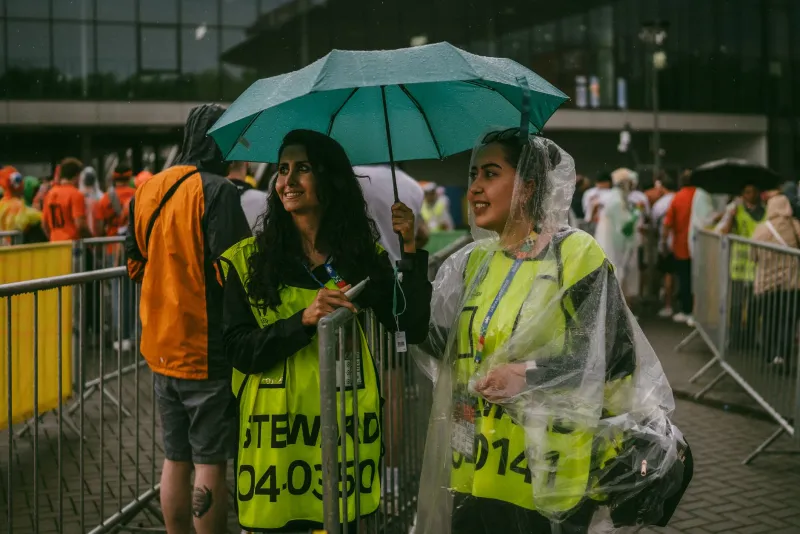
Stewards are not just there to point at bins. They know the layout, the lost child point and who has a radio. At the entrance, ask: 'What is the best meeting point if we get separated?' Some carnivals have a designated family welfare area. Some issue wristbands. Some have a lost child procedure that kicks in quickly.
Do not assume there will be a loudspeaker announcement. Even if there is, it may be hard to hear near the stage or the funfair. A steward with a radio is often faster than a tannoy.
Battery and signal plan
Crowds drain batteries and networks. Charge phones before you leave, bring a power bank if you have one, and screenshot a map of the site. Agree a check-in time, such as 2pm and 4pm, even if nobody is lost. That way everyone has a reason to return to the meeting point without anyone feeling like they are being checked up on.
If signal is patchy, texts often get through when calls do not. Put phones on low power mode, turn off unnecessary notifications and avoid streaming video in the middle of a field. For children without phones, the wristband and the script do the work.
First-timers: arrive early and walk the route
If it is your first time at a particular carnival, arrive before the crowds. Walk from the entrance to your meeting point. Point out the stewards, the first aid tent and the toilets on the way. Take a photo of the meeting point and a photo of each child in the morning, so you have an accurate description of what they are wearing later.
It sounds like over-planning for a fun day out. In practice, it takes five minutes and buys you a lot of calm.
When it goes wrong
Most families never need the plan. But if you do, the goal is not to panic. It is to make yourself findable and to give a steward the information they need. Stay at the meeting point, keep your phone on, and let the high-vis team do their job.
And once you are reunited, resist the urge to abandon the plan. A quick 'same place next year?' is usually enough. The flagpole has seen worse.