Draw First, Cheer Later: The Chalk Squares Turning Carnival Gaps Into Gallery Time
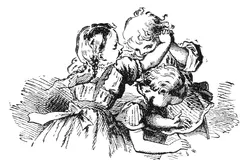
Photo: no illustrator or author listed, publisher was George Routledge and Sons of London, Public domain, via Wikimedia Commons
Carnival day has its own rhythm: a burst of drums, a swirl of feathers, a scramble for the kerb — then a long, warm gap while the next float inches into view. That gap is where the fidgeting starts. It is also where a small, cheerful tradition has taken root: the pavement chalk square.
You will have seen one. A parent crouches down, draws a wobbly box on the pavement, hands a stub of chalk to a five-year-old, and within minutes the square has become a zoo, a rainbow, a football pitch or a very ambitious portrait of a dog. By the time the bass drum returns, the pavement is a gallery and the children have forgotten they were bored.
The five-minute gallery that appears from nowhere
These chalk corners are rarely on any official map. They are not booked, branded or fenced off. They tend to appear in the loose pockets of pavement where families settle for the wait: beside a low wall, near a bench, in the shaded strip by a closed shop. One parent starts, another joins, and soon there is a shared box of chalks doing the rounds like a packet of biscuits.
“It is not organised, and that is exactly why it works,” says a family liaison volunteer at a Midlands carnival, who spends most of the parade in a high-vis tabard answering questions about toilets and lost buggies. “If a child is drawing, they are not running into the road. If a parent is kneeling beside them, they are not stressed. It gives everyone a little breathing space.”
Marshals we spoke to are broadly relaxed about it, provided the drawings stay on the pavement and well away from the route itself. The rule of thumb is simple: if a float, a dancer, a steward or a wheel could need that space, it is not a canvas. Kerbs, crossing points, dropped kerbs, drain covers and any surface with road markings are best left alone.
Where chalk is welcome — and where it is not
Organisers are understandably cautious about encouraging anything that looks like graffiti, so context matters. A chalk sun on a quiet stretch of pavement while you wait is one thing. Chalk on a shop window, a memorial, a church wall, a parked car or a private driveway is quite another. Ask a marshal if you are unsure. Most will point you towards a safe patch and quietly thank you for checking.
It also helps to keep chalk away from the performance footprint. Dancers, stilt walkers and musicians need room to move, and a chalk-drawn hopscotch grid in the middle of a turning circle is not the helpful gesture it might feel like. Stick to the family waiting areas, the edges of squares and the pavement beside the route rather than the road itself.
The washable rule, and why rain is not the enemy
Not all pavement chalk is created equal. The cheap, dusty sticks sold in tubs are usually the safest bet: they are designed to wash away with water and a bit of foot traffic. Oil pastels, chalk markers and anything labelled permanent are a different matter entirely. If the label says “outdoor” but not “washable”, treat it with suspicion.
A small test patch is a sensible first move, especially on paving that looks newly laid or unusually porous. Avoid spray chalk near costumes and pushchairs; a gust of wind can turn a neat drawing into a fine dusting of colour on somebody’s feathers. And if the forecast is for a dry week, a bottle of water and a cloth at the end of the day is a polite way to leave the pavement as you found it. Rain, when it comes, does most of the work for you.
A parent’s mini kit (keep it light)
You do not need much. A small tub of washable pavement chalk, a cloth or a pack of baby wipes, and a bottle of water will cover most situations. Some families bring a flattened cardboard box to sit on, which doubles as a drawing board and keeps knees out of the grit. A few chalks are better than a hundred; sharing a handful is part of the fun.
One parent from Leeds told us she now keeps a “carnival pocket” in her bag: three chalks, a wipe and a small folding raincoat. “It weighs nothing, and it has saved us during two long waits already,” she says. “The kids draw, I get ten minutes of peace, and the people next to us usually end up joining in.”
Why it stuck in 2026
Carnival organisers have spent recent years thinking hard about family experience: step-free routes, quiet corners, clearer meeting points and better signage. The chalk square fits neatly into that thinking because it costs almost nothing and asks almost nothing of the organisers. It is not a attraction, a stall or a scheduled activity. It is a small act of DIY hospitality that families have worked out for themselves.
That is also why it feels different from the commercial side of carnival. There is no queue, no ticket and no upsell. A box of chalk can be shared across a dozen children, and the drawing is gone by Monday. In a day full of noise and spectacle, it offers something quietly valuable: a patch of pavement that belongs to whoever is kneeling on it.
The etiquette bit
If you spot a chalk square forming, the unwritten rules are straightforward. Ask before joining someone else’s patch. Keep clear of performers, stewards, prams and wheelchairs. Do not draw on walls, windows, benches, bins or anything that is not plain pavement. Take your wrappers home, and leave the chalks for the next child if you can. And if a marshal asks you to shift, shift cheerfully — they are balancing a hundred small safety decisions you will never see.
Carnival is built on small traditions, most of which nobody planned. The chalk square is one of the newest, and one of the kindest. If you find yourself in a parade gap this year, look down. There may be a sun, a dinosaur or a very wobbly rainbow waiting for you. Add a line if you like. It will wash away by Monday.