Hi-Vis, High Signals: Decoding the Carnival Marshal's Silent Vocabulary
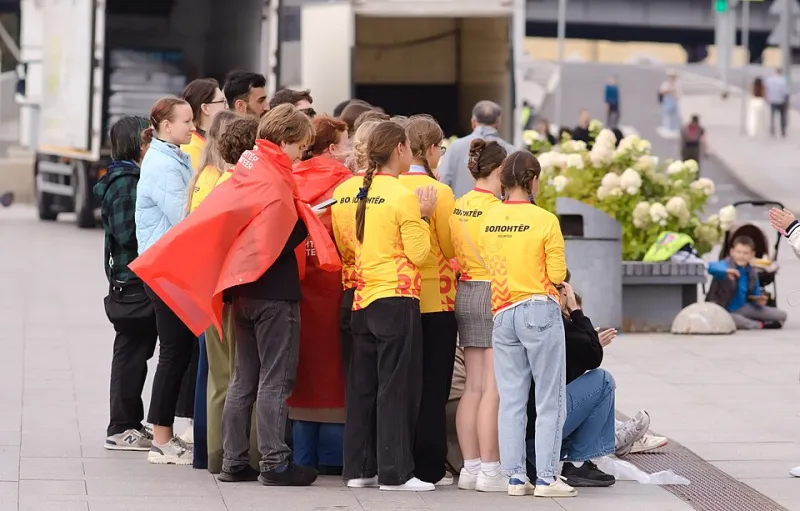
Photo: Retired electrician, CC0, via Wikimedia Commons
Stand near any carnival route in the UK for ten minutes and you'll notice something. The marshals in hi-vis rarely stand still. They lean, point, wave, whistle, frown at a gap in the crowd, then break into a grin when a buggy finally clears the kerb. It looks chaotic from the pavement. It isn't. Most of it is a working language — part hand signal, part radio shorthand, part exaggerated facial expression — and once you know a few of the basics, the whole parade becomes easier to read.
This isn't an official national code. Every carnival committee briefs its own volunteers, and a signal used in one town may mean something slightly different in the next. But across the route, certain habits repeat. Think of this as a family field guide to the hi-vis vocabulary you're likely to see in 2026.
Why Marshals Don't Just Shout
A carnival is loud. Brass bands, sound systems, generators, screaming kids on a funfair ride and the general happy hum of a high street all compete for attention. A marshal can shout until they're hoarse and still be heard by roughly nobody. A whistle cuts through. A flat hand is visible from thirty metres. A radio message gets the right person to the right corner without twenty people repeating the same instruction.
So marshals mix methods. Whistles are for attention and urgency. Hands are for movement and spacing. Radios are for logistics — first aid, lost children, a float that needs to pause, a barrier that has shifted. And facial expressions? Those are for the moments when words would be too slow or too polite. A grimace across the crowd can say 'please don't step out there' more effectively than a megaphone.
The Flat Palm: Carnival's Handbrake
The most common signal is also the easiest to miss. A marshal holds up one hand, palm facing you, and pats the air gently downwards. It means slow down, hold back or stop where you are. You'll see it at junctions, near float turns, by narrow pavement pinch points and anywhere a pram, wheelchair or small child is trying to get through.
If you see the flat palm, don't treat it as a telling-off. Treat it as a handbrake. Stop, look at the marshal, and wait for the next signal. The same goes for the palm held out like a traffic officer's stop sign. It usually means exactly that: stay put for a moment while something larger, noisier or more fragile moves past.
The wince is related. You'll know it when you see it — a marshal's face scrunching as someone ducks under a barrier or a child drifts towards the float's front wheel. The wince is not a universal signal, but it is a reliable clue that you should pause and look around before taking another step.
The Beckoning Wave and the Two-Finger Roll
A sweeping arm gesture — usually a marshal waving you forward with the whole arm — means move along, keep the crowd flowing, don't bunch up. At busy points, you may see a smaller version: two fingers flicking forward, like a gentle shoo. It's not rude. It's the carnival equivalent of a green light.
Float drivers watch for a different version of the same thing. A marshal walking backwards in front of a float, one arm extended, is usually setting the pace. If they hold up two fingers and flick them forward, they want the driver to keep rolling at walking pace. If they close their fist or show the flat palm, the float should ease off. Families on the pavement can use the same cues: when the marshal's arm sweeps, the gap is opening. When the palm goes up, the gap is closing.
Whistles: Short, Sharp and Worth Heeding
Whistle codes vary, so check the local programme if you're the sort of family that likes to be prepared. A single short blast often means 'attention' — look towards the marshal. Two short blasts usually mean 'hold' or 'stop'. A long blast is a stronger stop, and repeated blasts are a sign to stand still and look for instruction. Near a moving float, that is not the moment to keep walking while scrolling your phone.
One useful rule: don't assume a whistle is aimed at you. It might be for a driver, a fellow marshal or someone fifty metres away. But do assume it's worth a glance. A two-second pause can stop a small person stepping into the path of a tractor unit dressed as a pirate ship.
Radio Shorthand You Can Hear Without a Radio
Marshals often relay radio messages by hand. You'll hear fragments as you pass: 'copy', 'stand by', 'holding', 'clear', 'rolling', 'first aid', 'lost child'. These aren't secret code. 'Holding' means the parade is paused. 'Clear' means the route ahead is safe. 'Rolling' means the floats are moving again. If you hear 'lost child' near you, expect marshals to become very focused very quickly — and give them space.
The Point, the Thumbs-Up and the Double Point
A pointed finger is usually directional, not accusatory. If a marshal points at the ground in front of you, they want you to stand there. If they point at a barrier, they want you behind it. A thumbs-up is a thank-you, often given to a driver who has waited patiently or a family who has shuffled their buggy out of a gateway.
The double point — both hands pointing in the same direction — is a favourite at crossing points. It means look that way, then move. It's the carnival cousin of the Green Cross Code, delivered by someone in a fluorescent jacket and a Santa hat.
What Families Can Do With All This
Teach children that hi-vis means helper. If they get separated, tell them to find the nearest marshal rather than a random stranger. Agree a meeting point before you arrive, and make sure everyone knows the marshals are the people to ask for directions, first aid or lost property.
Keep buggy wheels and folding chairs clear of the route edge. If you need to cross, catch a marshal's eye and wait for the wave — don't read a wave aimed at a float as an invitation for you. And if a marshal gives you the flat palm, give them a thumbs-up back. It costs nothing and keeps the whole parade moving.
A Clearer Language for 2026
The best carnivals don't just rely on marshals knowing the signals; they help the crowd learn them too. A simple glossary in the programme, a few icons on a noticeboard, a short welcome announcement before the first float sets off — all of it reduces confusion. It also lets marshals spend less time repeating themselves and more time doing the job they volunteered for: keeping the day safe, calm and genuinely festive.
So next time you see a hi-vis arm shoot up, don't groan. Read it. The whistle, the wave and even the wince are all part of the same message: we're all here for a good day out, and a little shared language helps everyone get home smiling.